We use cookies to ensure our site functions properly and to store limited information about your usage. You may give or withdraw consent at any time.To find out more, read our privacy policy and cookie policy.
Manage Cookies
A cookie is information stored on your computer by a website you visit. Cookies often store your settings for a website, such as your preferred language or location. This allows the site to present you with information customized to fit your needs. As per the GDPR law, companies need to get your explicit approval to collect your data. Some of these cookies are ‘strictly necessary’ to provide the basic functions of the website and can not be turned off, while others if present, have the option of being turned off. Learn more about our Privacy and Cookie policies. These can be managed also from our cookie policy page.
Strictly necessary cookies(always on):
Necessary for enabling core functionality. The website cannot function properly without these cookies. This cannot be turned off. e.g. Sign in, Language
Analytics cookies:
Analytical cookies help us to analyse user behaviour, mainly to see if the users are able to find and act on things that they are looking for. They allow us to recognise and count the number of visitors and to see how visitors move around our website when they are using it. Tools used: Google Analytics
Share Tree Protection Pilot Program on FacebookShare Tree Protection Pilot Program on TwitterShare Tree Protection Pilot Program on LinkedinEmail Tree Protection Pilot Program link
Thank you to everyone who participated in the engagement process for Phase Two of this project. Engagement is now closed.
A summary report of what we heard will be available in late May 2026.
Background
In response to concerns about mature tree loss in the Sunshine Hills area, Council directed staff to explore a Neighbourhood Tree Protection Pilot Program. After reviewing available municipal tools, 2,693 property owners in the Sunshine Hills area were invited to share feedback on potential tree protection measures and interest in participating in the program through an online survey. A total of 564 property owners participated. Results from Phase One are available in the Community Engagement Report at letstalk.delta.ca/TreeProtection. Based on the input gathered, staff drafted bylaw amendments as part of the creation of the Tree Protection Pilot Program. The proposed amendments included:
Redefining a “large diameter” tree as 50 cm or greater
Removing the current allowance to remove one tree within a 24-month period without an arborist report
Introducing a “Significant Tree” definition with a higher threshold for removal and associated fees
At the March 9 Regular Meeting, Council directed staff to proceed with Phase Two of engagement to confirm interest in participating in the Pilot Program, as proposed, within the identified neighbourhoods. Feedback for Phase Two was collected between March 24 and April 15.
How Were Neighbourhoods Selected for the Phase Two Survey?
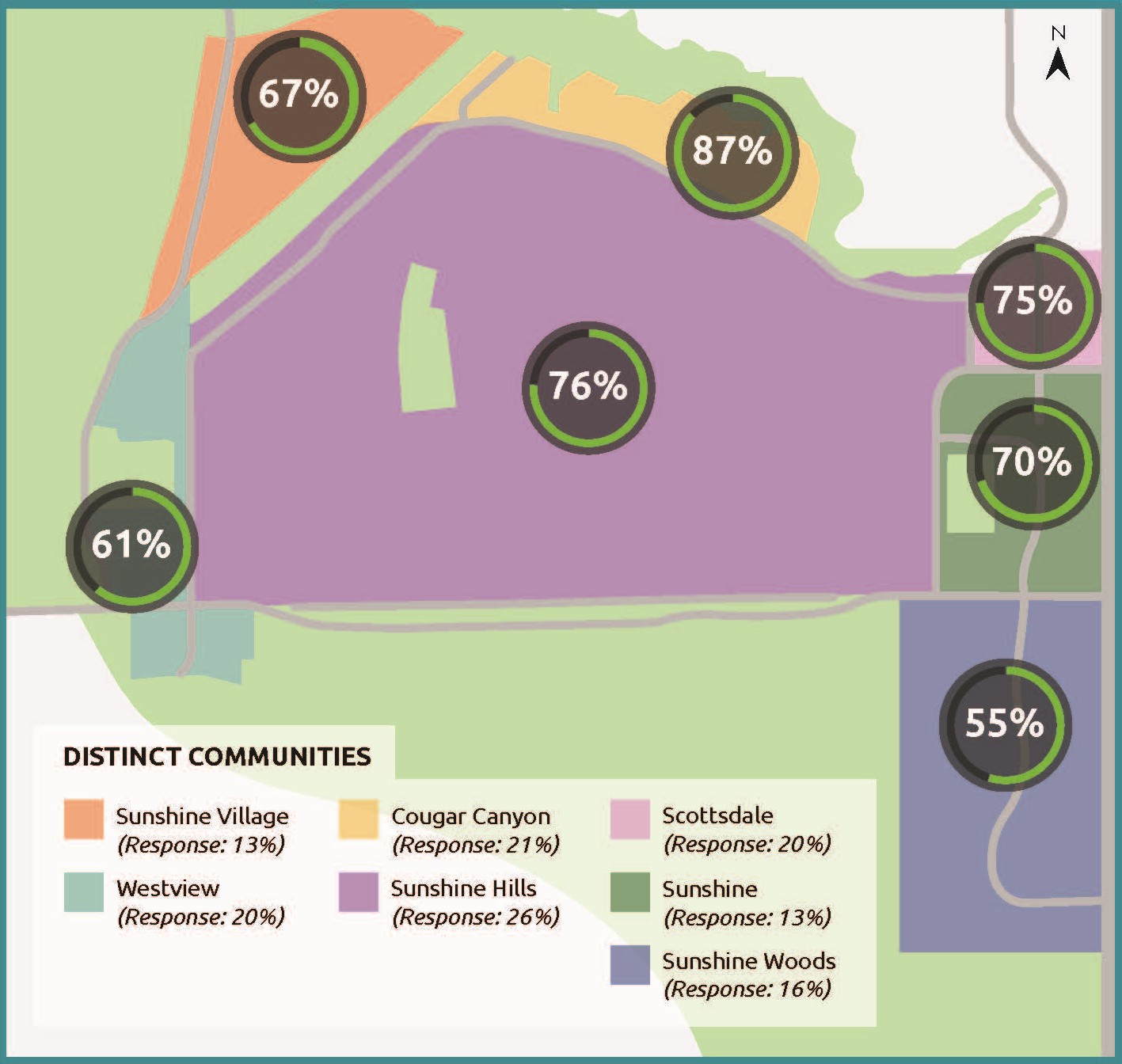
Neighbourhoods invited to participate in the Phase One survey are shown on the map below. The map illustrates both survey response rates and levels of support for the program. Neighbourhoods with 20% or more participation and 75% or more support for a neighbourhood-wide program were selected to participate in the Phase Two survey (Sunshine Hills, Cougar Canyon, and Scottsdale).
What Happens Next
Findings from Phase Two will help staff finalize recommendations to Delta Council on proposed bylaw amendments and implementation of the pilot program.
Thank you to everyone who participated in the engagement process for Phase Two of this project. Engagement is now closed.
A summary report of what we heard will be available in late May 2026.
Background
In response to concerns about mature tree loss in the Sunshine Hills area, Council directed staff to explore a Neighbourhood Tree Protection Pilot Program. After reviewing available municipal tools, 2,693 property owners in the Sunshine Hills area were invited to share feedback on potential tree protection measures and interest in participating in the program through an online survey. A total of 564 property owners participated. Results from Phase One are available in the Community Engagement Report at letstalk.delta.ca/TreeProtection. Based on the input gathered, staff drafted bylaw amendments as part of the creation of the Tree Protection Pilot Program. The proposed amendments included:
Redefining a “large diameter” tree as 50 cm or greater
Removing the current allowance to remove one tree within a 24-month period without an arborist report
Introducing a “Significant Tree” definition with a higher threshold for removal and associated fees
At the March 9 Regular Meeting, Council directed staff to proceed with Phase Two of engagement to confirm interest in participating in the Pilot Program, as proposed, within the identified neighbourhoods. Feedback for Phase Two was collected between March 24 and April 15.
How Were Neighbourhoods Selected for the Phase Two Survey?
Neighbourhoods invited to participate in the Phase One survey are shown on the map below. The map illustrates both survey response rates and levels of support for the program. Neighbourhoods with 20% or more participation and 75% or more support for a neighbourhood-wide program were selected to participate in the Phase Two survey (Sunshine Hills, Cougar Canyon, and Scottsdale).
What Happens Next
Findings from Phase Two will help staff finalize recommendations to Delta Council on proposed bylaw amendments and implementation of the pilot program.
Please review the questions listed below before submitting a new one. If your question is not already addressed, you may submit it using the form below. Questions submitted between March 24 and April 15 will be reviewed and responded to.
Share If a tree on the property is sick, causing structural damage to roofs, driveways, the house etc, will there be exemptions made for higher fees/ban on cutting the trees? If not, will we be able to get compensation for any damages caused by the tree from the government as it is these bylaw changes that resulted in the inability to prevent the damages? on FacebookShare If a tree on the property is sick, causing structural damage to roofs, driveways, the house etc, will there be exemptions made for higher fees/ban on cutting the trees? If not, will we be able to get compensation for any damages caused by the tree from the government as it is these bylaw changes that resulted in the inability to prevent the damages? on TwitterShare If a tree on the property is sick, causing structural damage to roofs, driveways, the house etc, will there be exemptions made for higher fees/ban on cutting the trees? If not, will we be able to get compensation for any damages caused by the tree from the government as it is these bylaw changes that resulted in the inability to prevent the damages? on LinkedinEmail If a tree on the property is sick, causing structural damage to roofs, driveways, the house etc, will there be exemptions made for higher fees/ban on cutting the trees? If not, will we be able to get compensation for any damages caused by the tree from the government as it is these bylaw changes that resulted in the inability to prevent the damages? link
If a tree on the property is sick, causing structural damage to roofs, driveways, the house etc, will there be exemptions made for higher fees/ban on cutting the trees? If not, will we be able to get compensation for any damages caused by the tree from the government as it is these bylaw changes that resulted in the inability to prevent the damages?
Celina
asked
about 1 month ago
The Delta Tree Protection and Regulation Bylaw currently allows for the removal of a tree without a permit if a qualified professional (i.e., a certified arborist) determines that the tree is dead, dying, or is in imminent danger of falling and causing injury to people or structures. This would continue under the pilot program. If a tree is causing unavoidable damage to a home, driveway, or other infrastructure over time, it can be removed with a permit. In these cases, standard fees and replacement requirements would apply. Removal is not permitted for minor nuisances such as shade or the dropping of needles or cones. The City does not provide compensation for damage caused by trees on private property, as property owners remain responsible for managing trees on their land. This approach would remain the same under the Neighbourhood Tree Protection Pilot Program.
Share Is the City considering rules and policies to minimize tree removal in new developments, on top of just increased fees and higher replacement requirement? Has the loss of environmental and neighbourhood benefits associated with removing multiple trees in a new developments been assessed wholistically, and how is the loss recouped by the the fees and young, smaller replacement trees? on FacebookShare Is the City considering rules and policies to minimize tree removal in new developments, on top of just increased fees and higher replacement requirement? Has the loss of environmental and neighbourhood benefits associated with removing multiple trees in a new developments been assessed wholistically, and how is the loss recouped by the the fees and young, smaller replacement trees? on TwitterShare Is the City considering rules and policies to minimize tree removal in new developments, on top of just increased fees and higher replacement requirement? Has the loss of environmental and neighbourhood benefits associated with removing multiple trees in a new developments been assessed wholistically, and how is the loss recouped by the the fees and young, smaller replacement trees? on LinkedinEmail Is the City considering rules and policies to minimize tree removal in new developments, on top of just increased fees and higher replacement requirement? Has the loss of environmental and neighbourhood benefits associated with removing multiple trees in a new developments been assessed wholistically, and how is the loss recouped by the the fees and young, smaller replacement trees? link
Is the City considering rules and policies to minimize tree removal in new developments, on top of just increased fees and higher replacement requirement? Has the loss of environmental and neighbourhood benefits associated with removing multiple trees in a new developments been assessed wholistically, and how is the loss recouped by the the fees and young, smaller replacement trees?
asked
3 months ago
Under the provincial Community Charter, the City’s power to protect trees on private property is limited if any development that is otherwise allowed is affected. Provincial legislation also requires municipalities to allow for more small-scale, multi-unit housing (e.g. 4-plex housing on all lots in residential neighbourhoods), however the City works with developers to protect trees through reasonable design changes.
The City’s Urban Forest Strategy, published in 2020, includes a goal to increase the urban canopy to 40% coverage by 2050, particularly in neighbourhoods currently exhibiting low canopy cover. The tree replacement requirements in our tree bylaw are intended to move us towards this goal. As well, about 1,000 trees are planted by staff each year throughout the City using cash-in-lieu collected from tree removals on private property.
Share Does the city track how many trees are being removed per year and has it increased? on FacebookShare Does the city track how many trees are being removed per year and has it increased? on TwitterShare Does the city track how many trees are being removed per year and has it increased? on LinkedinEmail Does the city track how many trees are being removed per year and has it increased? link
Does the city track how many trees are being removed per year and has it increased?
3 months ago
Yes. The City tracks tree removal permits issued each year. Since 2015, there has been an average of approximately 884 tree removals per year, though the number varies from year to year. The highest number of removals occurred in 2021 (1,181 permits), while the lowest was in 2022 (427 permits). More recently, 890 tree removal permits were issued in 2024 and 897 in 2025, which is generally consistent with the long-term average.
Share Of the 1000 trees that Delta plants each year, what is the breakdown between deciduous and conifer? on FacebookShare Of the 1000 trees that Delta plants each year, what is the breakdown between deciduous and conifer? on TwitterShare Of the 1000 trees that Delta plants each year, what is the breakdown between deciduous and conifer? on LinkedinEmail Of the 1000 trees that Delta plants each year, what is the breakdown between deciduous and conifer? link
Of the 1000 trees that Delta plants each year, what is the breakdown between deciduous and conifer?
3 months ago
Since 2015, the City has planted an average of approximately 1,064 trees per year, though the number planted varies annually. Detailed breakdowns by tree type are not readily available at this time for every year. However, in 2025, of the 908 trees planted, approximately 200 were coniferous and 414 were deciduous, with the remaining plantings made up of other tree types or plantings where species categorization was not recorded (e.g. Reforestation or riparian area plantings of mixed native species).
Share Why is this program being explored in Sunshine Hills and not across all of Delta? on FacebookShare Why is this program being explored in Sunshine Hills and not across all of Delta? on TwitterShare Why is this program being explored in Sunshine Hills and not across all of Delta? on LinkedinEmail Why is this program being explored in Sunshine Hills and not across all of Delta? link
Why is this program being explored in Sunshine Hills and not across all of Delta?
3 months ago
Council directed staff to explore a neighbourhood-specific pilot program in the Sunshine Hills area in response to concerns raised by residents about the loss of mature trees should the pilot proceed, other neighbourhoods across Delta may have the opportunity to opt in.
Share Why do we want to increase protection of trees? on FacebookShare Why do we want to increase protection of trees? on TwitterShare Why do we want to increase protection of trees? on LinkedinEmail Why do we want to increase protection of trees? link
Why do we want to increase protection of trees?
3 months ago
Mature trees provide environmental, neighbourhood, and community benefits, and the purpose of this work is to understand whether additional, neighbourhood-specific approaches could help retain these benefits while respecting existing property rights and development regulations.
Share Why are multiple trees allowed to be removed on one property during development? on FacebookShare Why are multiple trees allowed to be removed on one property during development? on TwitterShare Why are multiple trees allowed to be removed on one property during development? on LinkedinEmail Why are multiple trees allowed to be removed on one property during development? link
Why are multiple trees allowed to be removed on one property during development?
3 months ago
Tree removal permits, whether related to development or not, are reviewed and processed in accordance with existing City bylaws. Delta’s Tree Protection and Regulation Bylaw No. 7969 allows property owners to apply to remove multiple trees on their property, subject to the requirements and conditions set out in the bylaw.
Share Who do I contact if I am having trouble filling out the survey? on FacebookShare Who do I contact if I am having trouble filling out the survey? on TwitterShare Who do I contact if I am having trouble filling out the survey? on LinkedinEmail Who do I contact if I am having trouble filling out the survey? link
Who do I contact if I am having trouble filling out the survey?
3 months ago
If you are having trouble completing the survey, you can contact City staff for support by emailing TreeProtection@delta.ca. Staff can help answer questions or discuss alternative ways to share your feedback.
Share How does the City ensure arborist reports are accurate and meet professional standards? on FacebookShare How does the City ensure arborist reports are accurate and meet professional standards? on TwitterShare How does the City ensure arborist reports are accurate and meet professional standards? on LinkedinEmail How does the City ensure arborist reports are accurate and meet professional standards? link
How does the City ensure arborist reports are accurate and meet professional standards?
3 months ago
Arborist reports are reviewed at multiple stages of the process, including during the building permit application and when tree removal permits are issued. Reviews are carried out by plans examiners, the Urban Forestry team, and permit staff. The City works with a range of qualified professionals and verifies that arborists meet required professional accreditation standards. When there are reports that need further verification, staff conduct site visits to confirm information is accurate.
Share When will this program be implemented? on FacebookShare When will this program be implemented? on TwitterShare When will this program be implemented? on LinkedinEmail When will this program be implemented? link
When will this program be implemented?
3 months ago
The pilot is being explored through a phased engagement process, and no implementation date has been set. The City is currently in Phase One, which focuses on gauging interest from property owners and gathering feedback on what a pilot could include. The results will be summarized and presented to Council for consideration. If Council directs staff to proceed, property owners would be asked to review a draft pilot program for final confirmation before implementation.
Tree Protection Pilot Program has finished this stage
Feedback will be open for property owners in the Sunshine Hills area until February 15.
Step Two: Council Direction
Tree Protection Pilot Program has finished this stage
Findings from the survey will be summarized and presented to Council for direction.
Step Three: Confirm Pilot Program
Tree Protection Pilot Program is currently at this stage
On March 9, Council directed staff to proceed with Phase Two of engagement. Property owners in the identified neighbourhoods will be invited to confirm the programs direction.
Step Four: Implement Pilot Program
this is an upcoming stage for Tree Protection Pilot Program
The pilot program will be finalized and implemented in identified neighbourhoods.
Step Five: Council Update
this is an upcoming stage for Tree Protection Pilot Program
After implementation, staff will report back to Council on the program including an overview of outcomes.



Thank you for your contribution!
Help us reach out to more people in the community
Share this with family and friends